By Monica Bond
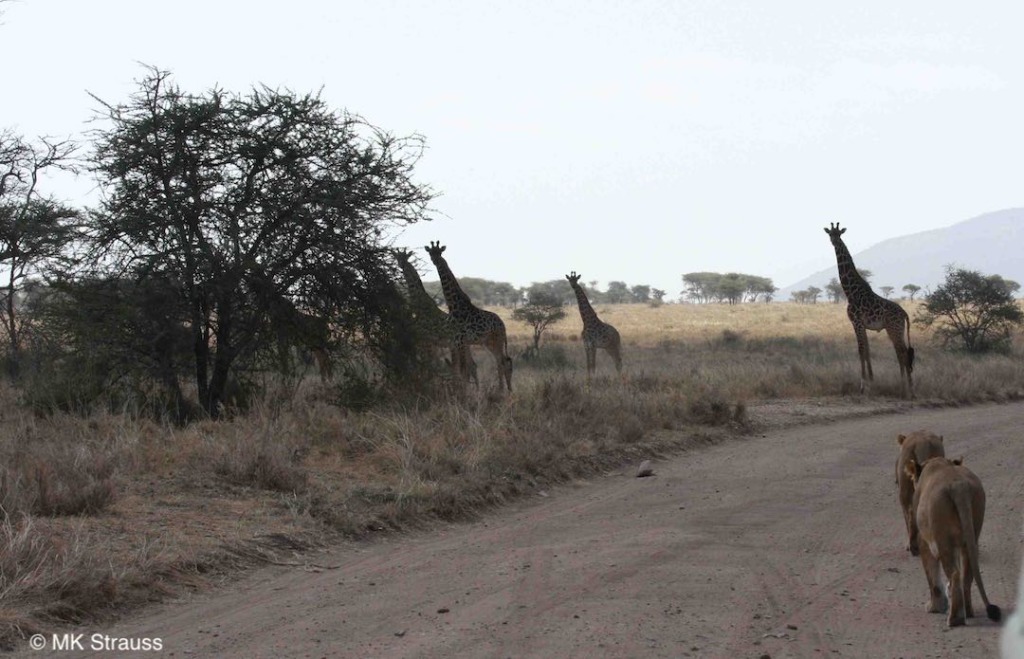
Life can be tough out there in the African savanna. Lions lurk in the bushes. Hyenas hide in the tall grass. Leopards lie in wait on an overhanging tree branch. What’s a giraffe to do about all that danger?
Giraffes are really (REALLY) tall and have great eyesight, but they can’t see everything all the time. They need to balance the time they spend sensing and avoiding danger with the time they spend eating, resting, hanging out with friends and family, and just going about their regular giraffe-y business.
Get by with a little help from your friends
One way to balance predator detection with everything else on the giraffe to-do list, is to get a little help from friends. “Prey species rely on different sensory cues from their environment to assess predation risk,” says Anton Baotic, a scientist in the Acoustics Research Institute at the Austrian Academy of Sciences.
Giraffes not only listen for sounds from the predators themselves, but “eavesdrop” on alarm calls from other species including birds, according to Anton’s research. But they need to determine how much to respond to the warnings, and whether to keep on doing whatever they were doing, or beat a hasty retreat and head for the hills.

To flee or not to flee?
Anton and fellow scientist Georgine Szipl studied giraffe responses to lion roars and bird alarm calls in seven reserves in South Africa. One of the reserves had lions that were introduced five years earlier, so the giraffes were exposed to predation, while the other reserves were lion-free.
In the first series of experiments, Anton and Georgine played lion roars and measured the responses of giraffes, like stopping eating, turning towards the sound, raising the head, scanning around, and either walking cautiously toward the sound to investigate or moving continuously away from the sound. The scientists also measured the giraffes’ ear postures like pricking them forward or backward.

It turns out that giraffes in the reserve where lions were present showed much stronger and constant vigilance responses to the lion roars than giraffes in the lion-free reserves. All of the giraffes turned toward the lion roars, but only the giraffes living with lions kept up the antipredator responses for a long time.
When there are no predators around, giraffes seem to relax their vigilance and don’t need to spend so much time dealing with a threat they don’t experience on a regular basis. So, they are always sensitive to and recognize the threat, but their experience with lions shapes how strongly they need to respond to the threat.
All the reserves had populations of red-billed oxpeckers, birds that perch on large mammals in Africa, picking and eating ticks off the skin and slurping blood from wounds. Oxpeckers not only help clean these mammals, they also produce loud “ksssss” alarm calls when they are disturbed, which can serve as a helpful early-warning system for their host.


In a related experiment to the lion roars, Aton and Georgine tested whether giraffes living with lions show a stronger vigilance response to the oxpecker warning call compared to giraffes living lion-free. Instead of lion roars, the researchers played the oxpeckers’ “kssss” alarm calls, as well as general “coo” calls from ring-necked doves and “plew” whistle calls from African black-headed orioles as control calls.
After hearing the oxpecker alarm calls, giraffes always responded with vigilance behaviors like directing their ears forward, turning toward the sound, and scanning around. But giraffes in the reserve with lions kept up their vigilance longer than those in the lion-free reserves. This proved that experience with their natural predators heightens giraffe responsiveness to bird alarm calls. Giraffes didn’t respond to the non-alarm dove and oriole calls, showing that they can filter those sounds out.
Keeping it to a dull roar
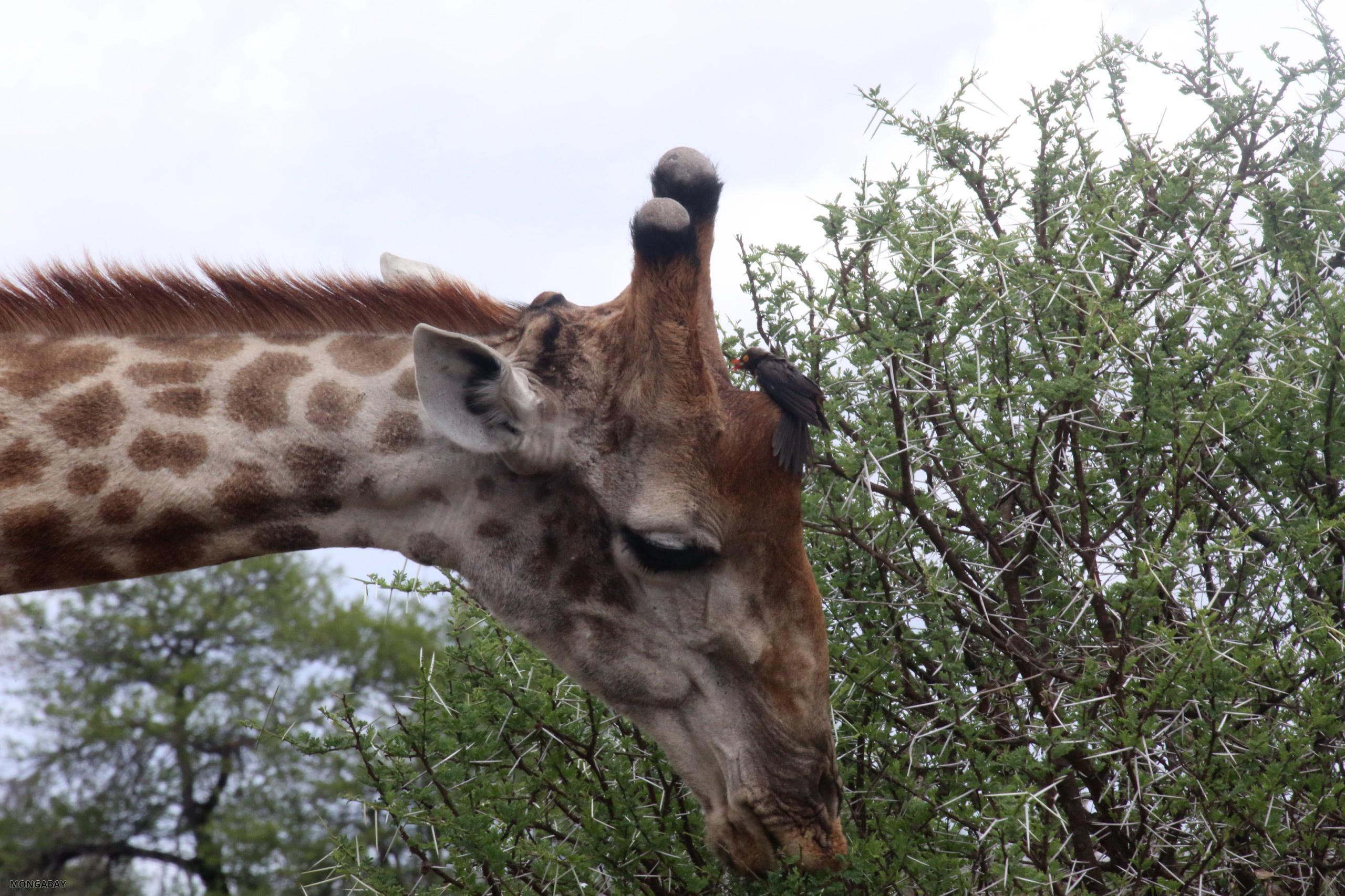
“Animals always have to adapt their vigilance strategies to balance eating and doing all the other things they need to do, with watching out for predators,” says Anton. “Giraffes are smart enough to recognize a cue that a predator might be around, like an actual lion roar or an oxpecker alarm call, but only giraffes living with predators spend extra time dealing with the threat.”
In other words, giraffes have a built-in fear of lions deep inside their brains, a necessary fear throughout their evolutionary history, but it seems they understand the real risk level and respond accordingly. Giraffes are beautiful AND clever!
Citations:
Baotic, A. & Szipl, G. (2025). Predator experience enhances giraffe vigilance to oxpecker alarm calls. BMC Biology, 23 (1), 304. doi: 10.1186/s12915-025-02395-5
Baotic, A. & Szipl, G. (2025) Learning to fear: predator recognition in giraffes is shaped by evolved sensitivity and ecological experience. Frontiers in Ecology & Evolution, 13:1634218. doi: 10.3389/fevo.2025.1634218
Monica Bond is a Principal Scientist for Wild Nature Institute.