Calling all nature detectives! Can you figure out which animals these noses belong to? Use the images and clues to solve the puzzle. Hint: These animals are all mammals.

Click the tab to view the answers. Good luck!


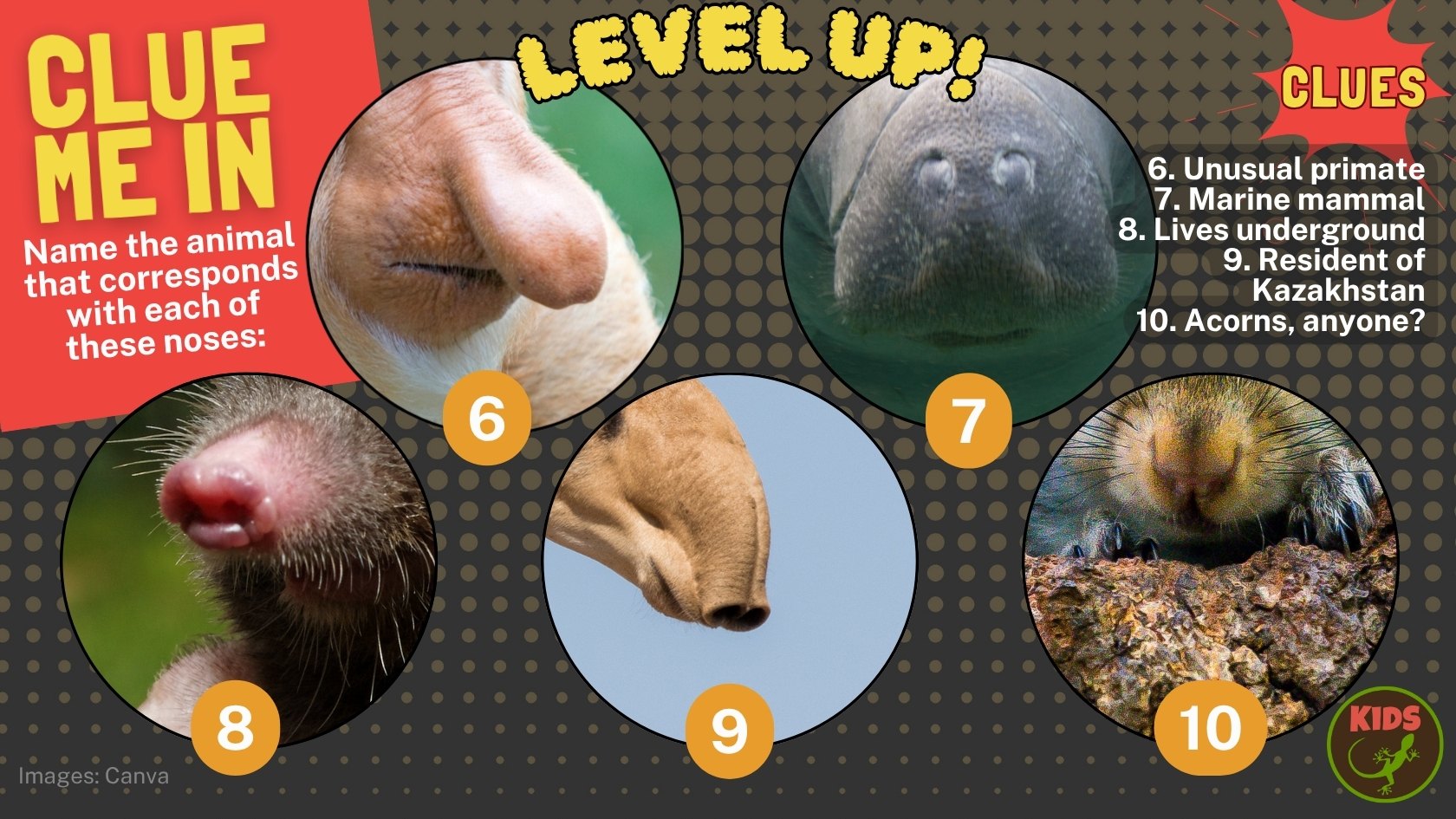
Click the tab to view the answers. Good luck!

Fun facts about noses

What is a nose? In mammals, the nose is the part of the face or snout that helps an animal breathe and smell.
Breathing: Air enters through the nostrils (openings of the nose). It then moves through a cavity inside the nose, where it is warmed or cooled, humidified, and filtered for dust and allergens. The clean, temperature-controlled air travels to the lungs.
Smelling (also called olfaction): Special receptor cells inside the nose pick up tiny particles that make up smells. These receptors send electrical signals to a structure in the forebrain called the olfactory bulb. The olfactory bulb then passes the information on to other parts of the brain. The brain interprets the smells and helps the animal recognize things like food, other animals, or even danger. (This video explains how humans smell.)

What is a proboscis? In mammals, a proboscis is a long, flexible nose. Aardvarks and tapirs have a proboscis. Can you guess which of the animals in the puzzle has a proboscis? (Find the answer at the bottom of the page.)
Did you know? An insect proboscis is not a nose, but a long mouthpart used for sucking up nectar or other liquids.

Did you know? An elephant’s trunk contains no bones! The trunk’s movement is due to an estimated 90,000 bundles of muscle fibers, called fascicles. Elephants use their trunks to breathe, drink, grasp objects, collect food, and clean themselves. Elephants also use their trunks to communicate with their friends and neighbors. An elephant can make an impressive trumpeting sound, by forcing air through its trunk!

Did you know? The rhinarium is the name for the hairless skin around the nostrils of many mammals, including canids (dogs), felids (cats), cows and deer, rodents, bears, elephants, lemurs, and walruses.
Why do some animals have a wet nose? Scientists are still trying to figure out why some animals, like dogs, have a moist rhinarium. A wet nose may help animals detect odors, pick up wind direction, and even detect heat.
ANSWER: Elephant, moose, mole, proboscis monkey, and saiga antelope.