Humans have been to Earth’s moon and mapped most of its surface in detail using satellites and telescopes. We have even sent space probes to map the surface of Mars. But do you think we have seen every part of the Earth’s surface in detail?
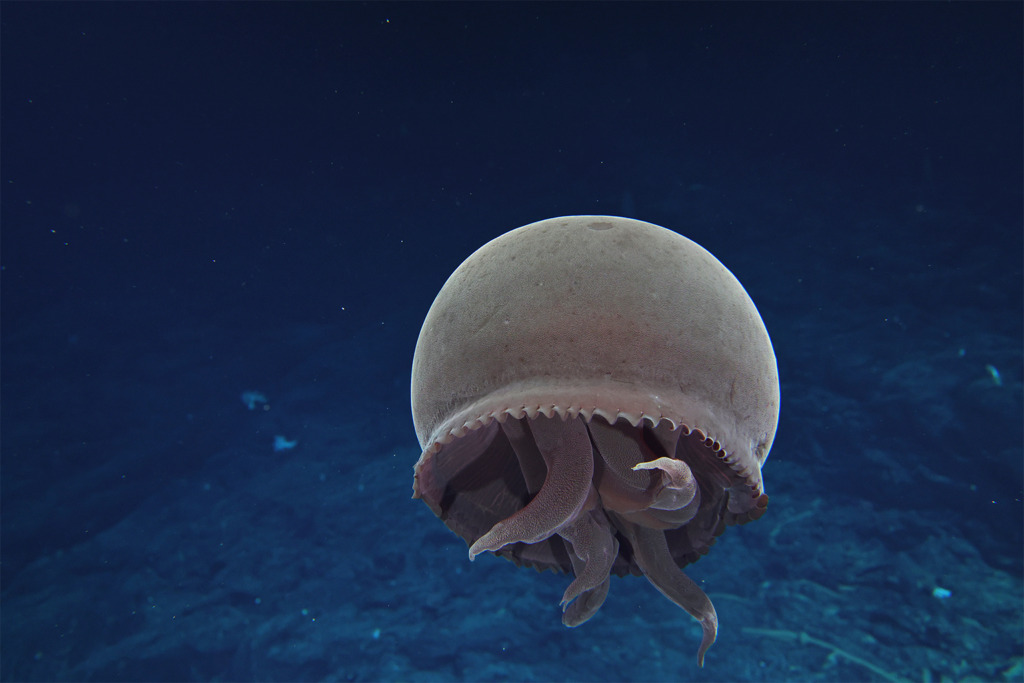
If you guessed yes, then guess again! Just 0.001% of the Earth’s deep seafloor has ever been captured by photo or video images, mostly in the waters of the United States, Japan, and New Zealand.
The deep sea is one of the hardest areas on Earth to study. The crushing pressure created by gravity, along with absolute darkness, make it hard to reach and navigate safely.
“We know more about the dark side of the moon than we do about this, the deep seafloor,” says Kenneth Macdonald, a marine geophysicist and professor emeritus at University of California Santa Barbara.

Researchers have used seafloor mapping, which involves the use of sonar, more than imaging. Sound waves travel farther than light waves. More than a quarter of the seafloor has been mapped this way, thanks largely to a major international project called Seabed 2023 that is currently underway.
Seafloor imaging began in 1958. Many of the remote operating vehicles (ROVs) that are used to capture imagery move at below 1 mile per hour. The ROVs can only see an area 10 meters (33 feet) wide. The ROVs cost millions of dollars each and often require big research vessels to bring them out to sea. It can cost roughly $100,000 a day to have an ROV visualize the seafloor.
Katy Croff Bell helped estimate how little of the Earth’s deep sea floor has been mapped with photographs or videos. “We’ve only seen 0.001%, and look at how much we know [from that] 0.001%,” she told Mongabay. “How much do we not know that’s yet to be discovered?”
David Brown adapted this story for Mongabay Kids. It is based on an article by Edward Carver, published on Mongabay News.