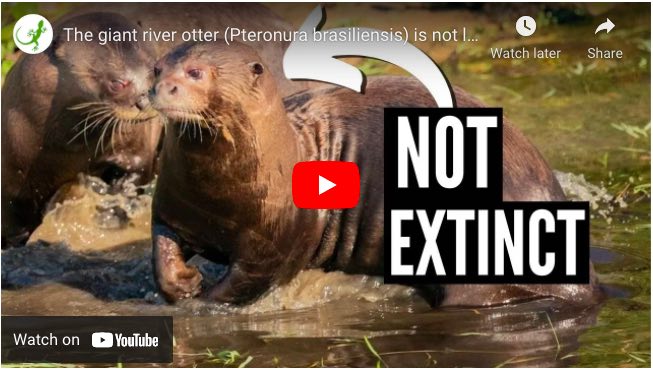
In July 2025, a family of giant river otters was released into the Iberá National Park in northeast Argentina. This is exciting news because these otters were probably extinct in Argentina.

Giant otters (scientific name: Pteronura brasiliensis) are the largest otter species in the world. A giant otter can grow to 1.8 meters (nearly 6 feet) in length, as large as an adult human. It can weigh as much as 34 kilograms (75 pounds), or as much as a 10-year-old human.
Giant otters live in South America. Originally, their range stretched from northern Venezuela to Uruguay. But because they were hunted for their fur, giant otters disappeared from many places. Almost 5000 giant otters live in Brazil, but there are only small populations left in Paraguay, Ecuador, and Guyana. In Argentina giant otters disappeared in the 1980s.
Conservation group Rewilding Argentina led the release of the giant otter family, a breeding pair named Coco and Nima, and their offspring, named Pirú and Kyra. The family of four now swims freely in Laguna Paraná, a lake in the Iberá National Park wetlands.
“This is the first time this species has been reintroduced to a place from where it had disappeared,” Rewilding Argentina wrote on Instagram. “It’s also the first time a mammal declared extinct in Argentina has been brought back.”
“The last family groups of giant otters in Argentina were observed in 1986,” said Sebastián Di Martino from Rewilding Argentina. “The giant otter is the top aquatic predator in these wetlands, and its diet consists almost entirely of fish, so its presence contributes significantly to maintaining healthy ecosystems.”
David Brown adapted this story for Mongabay Kids. It is based on an article by Shanna Hanbury, published on Mongabay News.