Each year, scientists describe thousands of new animals, plants, and fungi. In fact, it is thought that fewer than 20% of Earth’s species have been documented by Western science.
Did you know? Although a species may be new to science, that doesn’t mean it has never been seen before. Local and Indigenous guides often show scientists where to find new species and some already have local names.
Here are five of the incredible new-to-science species described in 2025:
1. A new manta ray

Scientific name: Mobula yarae
Where: Found only in the western Atlantic and stays close to shore
Fun fact: The newly described Atlantic manta ray looks similar to its two manta ray cousins, but it has unique V-shaped white shoulder patches and a lighter-colored face.
2. A new parrot snake

Scientific name: Leptophis mystacinus
Where: Brazil’s Cerrado, a threatened tropical savanna
Fun fact: This snake is named for the unique black stripe across its snout that looks like a mustache. Mystacinus means “mustache” in Greek!
3. A new guitar shark

Scientific name: Family Rhinobatidae
Where: Discovered along the coasts of Mozambique and Tanzania
Fun fact: Guitar sharks are actually a type of ray. Their flat bodies are shaped like an electric guitar!
4. A new mouse opossum

Scientific name: Marmosa chachapoya
Where: High-altitude cloud forests of Peru
Fun fact: This new marsupial has reddish-brown fur, a long snout, and a tail that’s longer than it’s head and body combined!
5. A new ‘fairy lantern’ plant
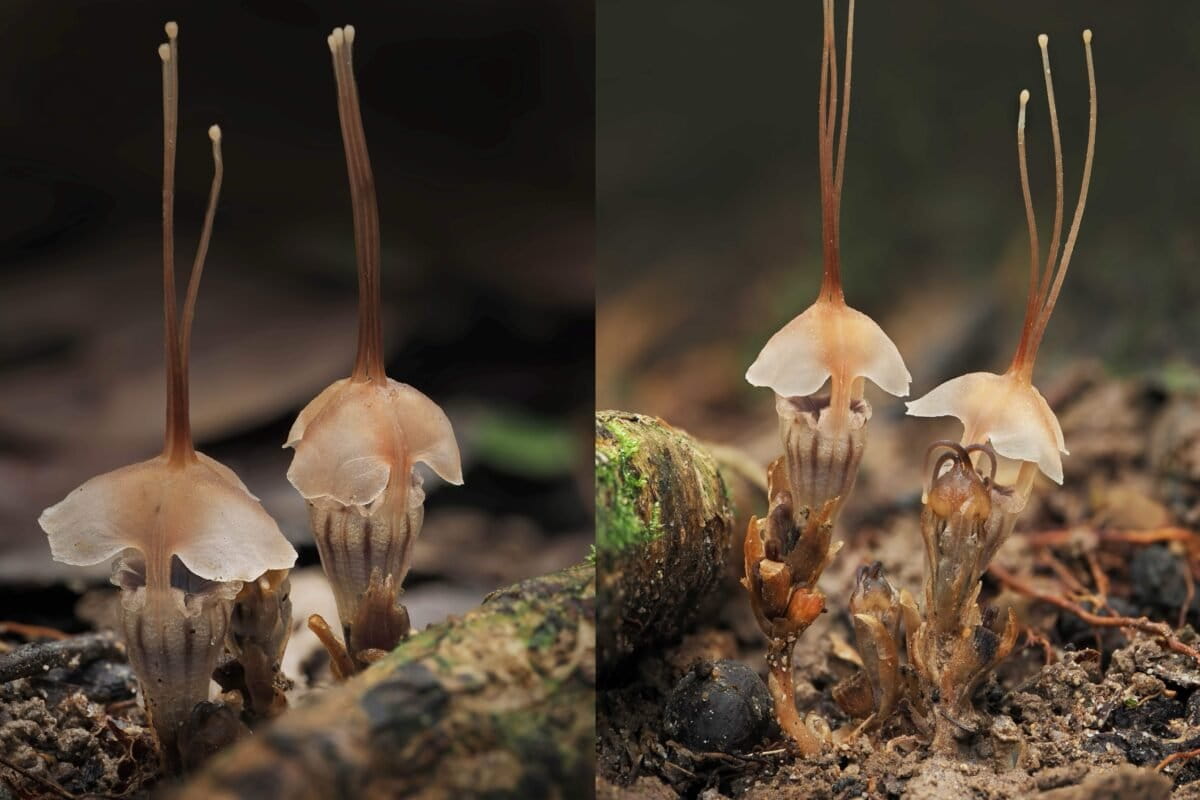
Scientific name: Thismia selangorensis
Where: Found at a picnic site in Malaysia’s Hulu Langat Forest Reserve
Fun fact: Fairy lantern plants live mostly underground. They can’t make their own food because they lack chlorophyll, so they steal nutrients from fungi instead!
Educator tip: Start a conversation about what it means to discover a new species. Scientists name thousands of new plants, animals, and fungi every year! Many times, Indigenous and local people know about these species and help scientists find them. So what does it mean for a species to be new to science? And why is it important to name and describe new species? Read this article to learn more.
This story has been adapted for Mongabay Kids, based on an article by Liz Kimbrough. Discover more new-to-science species of 2025 at Mongabay.com.