By David Brown
What was that thing darting behind the dumpster?
OH YUCK. A RAT!
Rats show up where we do not want them: our workplaces, our schools, our homes. Wherever humans live, there is a good chance rats live nearby too.
There are good reasons not to like rats. They contaminate human food. They chew up electrical wire and walls. They spread disease.
But hold on a second. Are there any reasons why people should like rats? Do rats help people in any way?
1. Meet your neighbors

There are many species of rats, but the brown rat is the rat that lives near most people. The brown rat is sometimes called the Norway rat, even though experts believe it originally came from Asia. Now, brown rats have spread all over the planet with us. Wherever there is a human farm, town, or city, there are probably brown rats lurking about.
The only rat-free places are Antarctica, some islands where rats never arrived or have been eliminated, and the province of Alberta in Canada.
Why Alberta? Alberta set up a rat control program in 1950 that keeps rats from establishing a breeding population. If you see a rat, you can file a rat report. Did you know? It’s also illegal to own pet rats in Alberta.
2. What do rats want from us?

Rats like living near people because we give them a constant supply of food and places to live and have babies.
The human world is one giant restaurant for rats. Rats eat just about anything edible that they can find. Rats don’t care if the food is in your pantry or in the trash. They eat fruits, vegetables, and grains that we grow on farms and in gardens. They chew up things we wouldn’t even think about eating, like plastic, wood, and building insulation.
Rats hide and build nests almost anywhere. They set up homes in basements, sewers, attics, barns, sheds, and walls. An adult rat can squeeze itself under gaps in doors and through a hole as small as a quarter in size. A female brown rat can raise as many as 100 babies in her lifetime.
3. Why don’t people like rats?

There are many reasons that people do not want brown rats or other rat species around them. Rats can cause a lot of property damage. Rats need to constantly chew on things to keep their teeth from growing too long (this is a common problem for rodents). For rats, their surroundings are one big chew toy. Rats have started fires by chewing through electrical wires!
One of the biggest reasons that people are anti-rat is that rats can carry dangerous diseases. In human history, black rats, a cousin of brown rats, contributed to the spread of bubonic plague that caused tens of millions of human deaths. The Black Death in Europe in the 1300s may have killed as many as 50 million people. Brown rats help spread a disease called leptospirosis that kills more than 50,000 people a year. Leptospirosis is caused by a bacterium in the pee of infected animals.
4. Rats help us learn about ourselves

The idea of the “lab rat” is fundamental for human health. Scientists use rats as model animals to understand human health. Lab rats help medical researchers treat conditions like diabetes, Parkinson’s disease, and strokes.
Lab rats also help us better understand behavior and psychology. Lab rats run mazes and solve puzzles, and the results help scientists figure out how mammal brains work. From these experiments, scientists have learned that rats will help other rats when they are trapped. Rats like to play. Rats laugh.
Lab rats are domesticated brown rats, the same yucky rats that we want to keep away from us. The rats that people keep as pets are also domesticated brown rats.
Not all rats make us go YUCK, and some rats we actually want around us.
5. Road rats
Neuroscientist Kelly Lambert and her colleagues at the University of Richmond taught rats how to drive. The rats drive a little car called the ROV (Rodent Operated Vehicle). Professor Lambert and her team study neuroplasticity, or how the structure of the brain changes in response to changes in the environment.
They found that rats raised in cages with lots of toys and things to do are much better at learning how to drive than rats raised in typical boring cages. Their research suggests that an interesting environment helps the brain learn more effectively than a dull one.
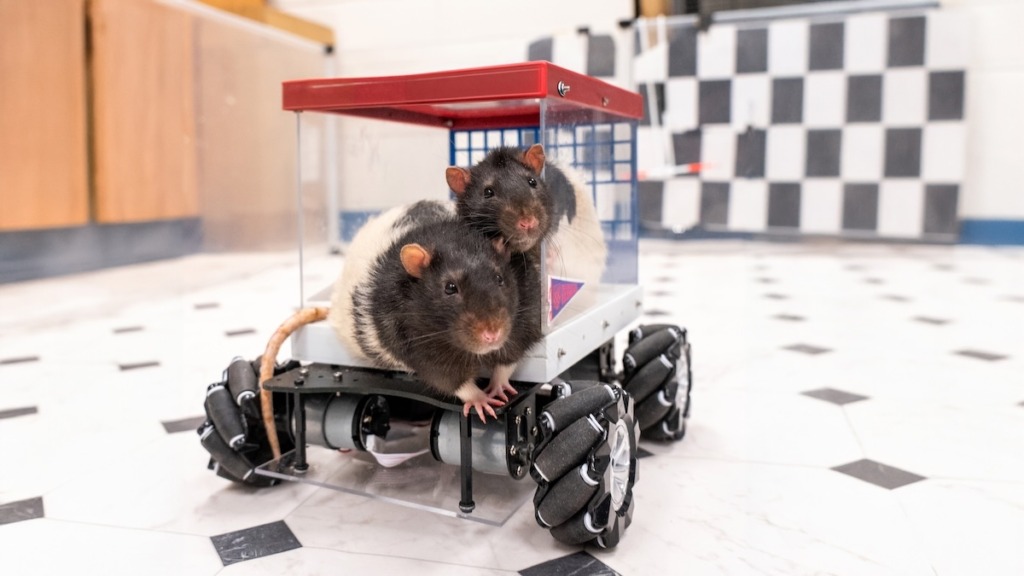
The research team also found that the rats love to drive just for the fun of it. When offered the opportunity to drive to a treat (Froot Loops cereal) or walk to it, the rats hopped in the ROV and drove. Even when there was no treat, the rats liked driving. This is another thing that rats and people have in common.